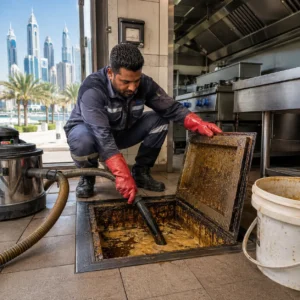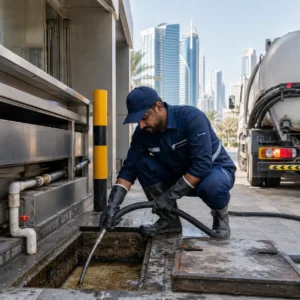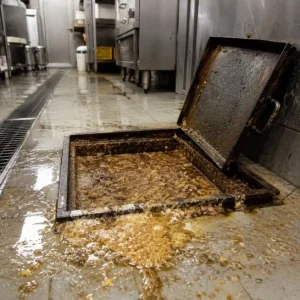
Choosing the right grease trap is not simply a matter of picking the biggest or cheapest unit. The trap needs to match the kitchen’s FOG output, drainage setup, available space, and approved design requirements. A small café with limited food preparation may have very different needs from a busy restaurant or hotel kitchen. If you’re arranging grease trap cleaning in Dubai, understanding the difference between compact and larger-capacity systems can also help you identify whether your current setup is suitable.
In simple terms, smaller grease traps are generally suited to lower-volume kitchens, while larger grease interceptors are designed for commercial operations producing substantially more grease and wastewater. The correct choice should be based on the actual kitchen operation and approved installation requirements—not restaurant size alone.
Type A Grease Traps: Where Smaller Units Make Sense
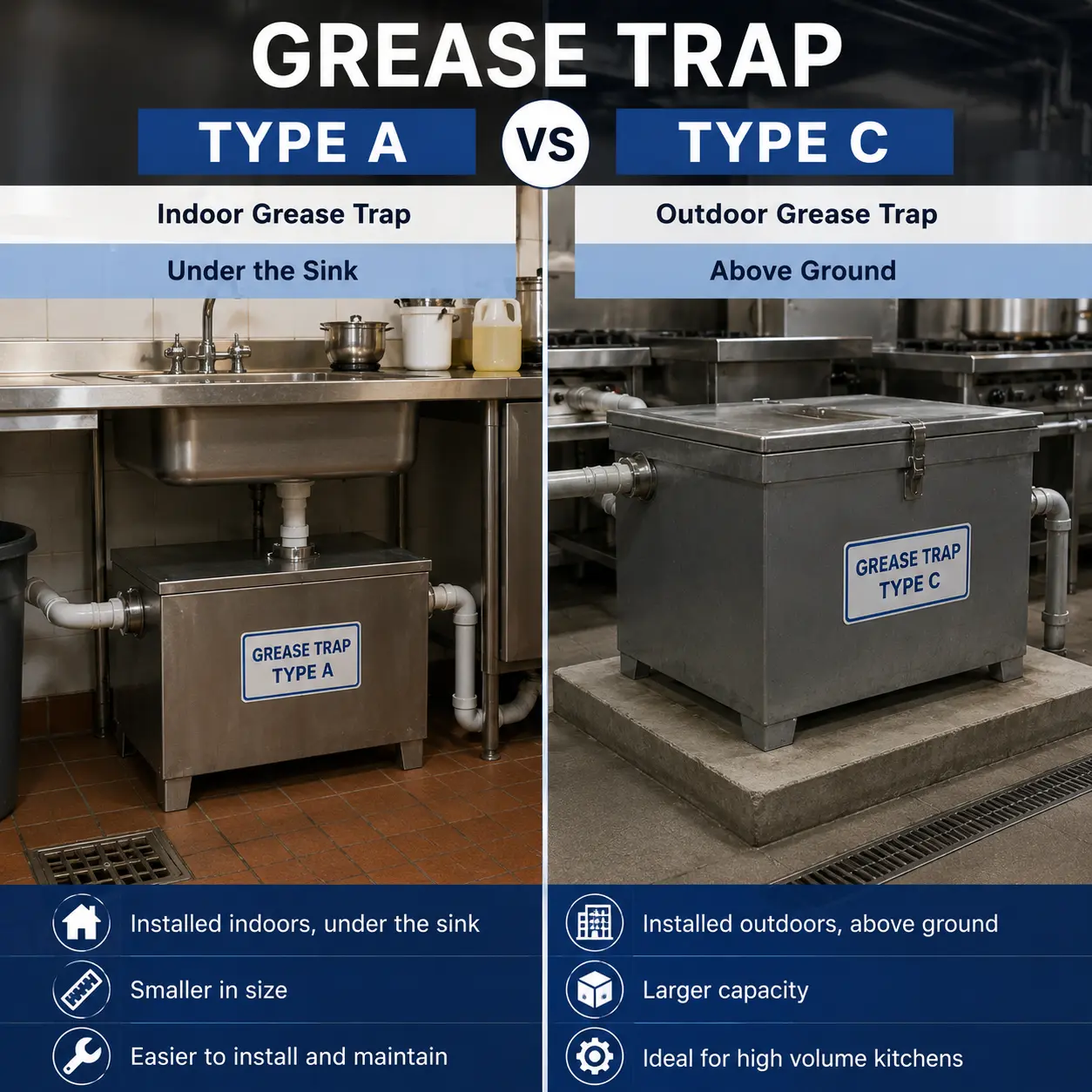
Type A is commonly used to describe a compact grease-trap setup installed close to a sink or kitchen drainage point. These systems can be practical where grease production is relatively limited and there is little space for a larger interceptor.
They may be suitable for:
- Small cafés with limited cooking
- Coffee shops with light food preparation
- Small takeaway operations
- Kitchens with relatively low FOG output
The main limitation is capacity. A compact trap can reach its effective capacity quickly when a kitchen produces large amounts of cooking oil, grease, or food residue. In that situation, frequent cleaning may not solve the underlying problem if the system itself is undersized.
Type C Grease Traps: When More Capacity Is Needed
Larger grease traps or grease interceptors are designed for commercial kitchens with significantly higher wastewater and FOG loads. Dubai Municipality’s guidance specifically notes that large grease traps, commonly called grease interceptors, are used for facilities such as hotels, malls, and large restaurants.
These systems are more appropriate for operations such as:
- Large restaurants
- Hotel kitchens
- Catering facilities
- Central production kitchens
- High-volume food-service operations
They require more installation space and can involve greater installation and maintenance costs, but the additional capacity can make them more suitable for a high-output kitchen.
Type A vs Type C: What’s the Difference?
| Factor | Type A / Compact Trap | Type C / Larger Interceptor |
| Typical use | Lower-volume kitchens | High-volume commercial kitchens |
| Size | Compact | Larger capacity |
| Location | Often close to kitchen fixtures | Often installed in a dedicated or external area |
| FOG load | Lower | Higher |
| Space required | Less | More |
| Maintenance needs | Can require frequent servicing if heavily used | Designed to handle greater volumes |
| Typical users | Small cafés and light-food outlets | Restaurants, hotels and catering operations |
Important: These labels should not be treated as a substitute for the actual approved design or sizing requirements for your premises. The appropriate system depends on the commercial activity, drainage design, expected wastewater flow, and site conditions.
How Do You Know Which Grease Trap Your Kitchen Needs?
Start with the way your kitchen actually operates rather than choosing based on floor area.
1. Look at Your FOG Output
A menu with frequent deep frying, oily sauces, meat preparation, or heavy use of cooking fats can send significantly more FOG into the drainage system than a café serving mainly drinks and light snacks.
2. Consider Kitchen Volume
The number of meals prepared and the amount of wastewater generated each day are important factors. A busy kitchen can quickly exceed the practical capacity of a small trap.
3. Check the Existing System
If your trap regularly overflows, develops strong odours, or requires cleaning unusually often, don’t automatically assume that you simply need more frequent servicing. The capacity, installation, drainage flow, and condition of the system should be assessed.
4. Consider Available Installation Space
A larger interceptor may be appropriate from a capacity perspective but may require a suitable external or dedicated installation area. The final setup should be confirmed against the property’s approved plumbing and drainage requirements.
Can a Small Restaurant Need a Large Grease Interceptor?
Yes. Restaurant size alone does not determine grease-trap requirements.
A relatively small restaurant with a high-F0G menu can produce more grease than a larger café with limited cooking. This is why trap selection should consider the kitchen’s actual operation, wastewater flow, and FOG production.
For an existing kitchen, frequent overflow or rapid grease accumulation is a reason to have the system assessed rather than simply increasing the cleaning frequency.
What Happens If the Trap Is Too Small?
An undersized system can become difficult to maintain because it reaches its capacity quickly. You may notice:
- Grease returning soon after cleaning
- Persistent drain odours
- Slow drainage
- Frequent trap overflow
- Increased cleaning requirements
- Grease entering downstream drainage
Regular maintenance remains important, but cleaning cannot compensate for a system that is fundamentally unsuitable for the kitchen’s requirements.
Cleaning Frequency Depends on the Kitchen
There is no universal cleaning interval that applies to every grease trap. Frequency depends on the trap capacity, kitchen volume, FOG production, and buildup observed during servicing.
A small, heavily used trap may need attention more often than a larger interceptor serving a similar type of business. Monitoring actual buildup between services is a better way to establish a practical maintenance schedule.
What About Dubai Municipality Requirements?
For Dubai food establishments, grease-trap installation and sizing are part of the wider drainage and waste-management requirements. Dubai Municipality’s guidance states that food-oil and grease producers must install suitable traps and that trap sizing is supervised through the relevant building-permit process according to the type and size of the commercial activity.
That means restaurant owners should not select a trap based solely on price or a generic online recommendation. The proposed system should be checked against the property’s approved design and applicable requirements.
Grease Trap and Other Drainage Maintenance
Grease traps are only one part of a commercial property’s wastewater system. If you’re planning wider drainage maintenance, it’s useful to understand sewage tank cleaning frequency and what to do during a sewage overflow emergency in Dubai. These are separate services, but understanding both systems helps restaurant and facility managers plan broader wastewater maintenance.
Not Sure Which Grease Trap Your Kitchen Needs?
The right setup depends on your kitchen’s output, drainage arrangement, existing trap, and site requirements. Frontline Cleaning Services can assess the existing system and advise on the appropriate cleaning or maintenance approach for commercial kitchens in Dubai and Sharjah.
Request an assessment before replacing or upgrading a grease trap.
Frequently Asked Questions
Is Type A better than Type C?
Neither is automatically better. A compact system can be appropriate for a lower-volume kitchen, while a larger interceptor is generally more suitable where FOG and wastewater loads are high.
Can a café use a larger grease interceptor?
Yes, where the kitchen’s output, drainage design, or approved installation requirements call for greater capacity. The decision should be based on the actual site rather than the business name alone.
How do I know if my grease trap is undersized?
Frequent overflow, rapid grease buildup, persistent odours, and repeated drainage problems despite proper cleaning can indicate that the system needs assessment.
Does a larger grease trap need less cleaning?
Not necessarily. A larger capacity can allow it to handle more grease before reaching its limit, but cleaning frequency still depends on actual FOG production and the condition of the trap.
Should I choose a grease trap based only on restaurant size?
No. Menu type, FOG production, wastewater flow, trap capacity, installation space, and approved drainage requirements all need to be considered.