Yousef Khan | Senior Cleaning Supervisor | Frontline Cleaning Services
Understanding Dubai’s water tank cleaning regulations is essential for maintaining safe water quality and meeting local health requirements. Many property owners focus on cleaning only when a problem arises, but regular maintenance and compliance are equally important.
As a Senior Cleaning Supervisor at Frontline Cleaning Services, I’ve worked with residential buildings, villas, and commercial properties across Dubai for over 10 years. During inspections, I’ve seen many water tanks that appeared clean but contained sediment buildup or failed to meet recommended maintenance standards because cleaning schedules were overlooked. This guide explains Dubai’s 2026 water tank cleaning regulations, recommended cleaning intervals, and the practical steps property owners can take to remain compliant and protect their water supply.
Quick Answer: Dubai Municipality advises residents to clean and disinfect domestic water tanks and plumbing systems at least once every six months using an approved company. Property owners should also keep cleaning records, inspect tank covers and fittings, and respond immediately to changes in water colour, smell, or taste.
For managed or higher-risk facilities, inspectors may review water samples, cleaning and sterilisation reports, preventive-maintenance records, and the condition of the internal water-supply network.
Do not wait for visible contamination. Review your last service date today and schedule an inspection if six months have passed or the tank’s condition is uncertain.
Why Water Tank Regulations Matter in Dubai
Water tanks can accumulate sediment, dust, organic matter, and microbial contamination when covers, vents, pipes, or internal surfaces are poorly maintained. Dubai’s heat and long storage periods can make preventive maintenance especially important.
Dubai Municipality launched its “Safe Water for a Healthy Community” initiative in March 2025 and advised residents to clean and disinfect tanks and plumbing systems at least every six months through approved companies. This official guidance provides a more reliable maintenance benchmark than unsupported cleaning schedules found online.
A compliant maintenance plan protects more than water appearance. It helps property owners demonstrate responsible management when responding to tenant complaints, facility inspections, water-quality concerns, or maintenance audits.
How Often Should Water Tanks Be Cleaned?
For domestic systems, Dubai Municipality advises cleaning and disinfection at least every six months. Tanks should be inspected or cleaned sooner when there is evidence of contamination, structural damage, water stagnation, or an unusual change in water quality.
Immediate professional attention is recommended when you notice:
- Cloudy or discoloured water
- Sediment inside the tank
- Unusual taste or odour
- Algae or slime
- Insects near the opening
- A loose or damaged lid
- Cracks, corrosion, or deteriorated coatings
- Water that remained unused for a long period
- Complaints from residents or building users
Commercial, educational, hospitality, healthcare-related, and other managed facilities may have additional risk-based maintenance, testing, or documentation requirements. Dubai Municipality has reported reviewing tank cleaning, sterilisation, water-quality, and preventive-maintenance records during inspections of relevant institutions.
Check the date on your latest cleaning report. When records are missing or outdated, arrange a documented inspection rather than assuming the tank is safe.
Use an Approved Water Tank Cleaning Company
Dubai Municipality provides an approval route for businesses conducting water-tank-cleaning activities. Property owners should therefore verify that a contractor holds the licences and current approvals relevant to the work rather than accepting an unsupported claim of being “certified.”
Before hiring a provider, request:
- A valid trade licence
- Evidence of approval for water-tank cleaning
- A written cleaning and disinfection method
- Details of the products being used
- Technician safety procedures
- Before-and-after photographs
- A tank-condition report
- Corrective recommendations
- Clear pricing and exclusions
A professional water cleaning Service in Dubai should explain how the tank will be isolated, drained, physically cleaned, disinfected, rinsed, inspected, and safely returned to service.
Request written proof of approval and a complete service scope before confirming the booking.
What a Compliant Cleaning Process Should Include
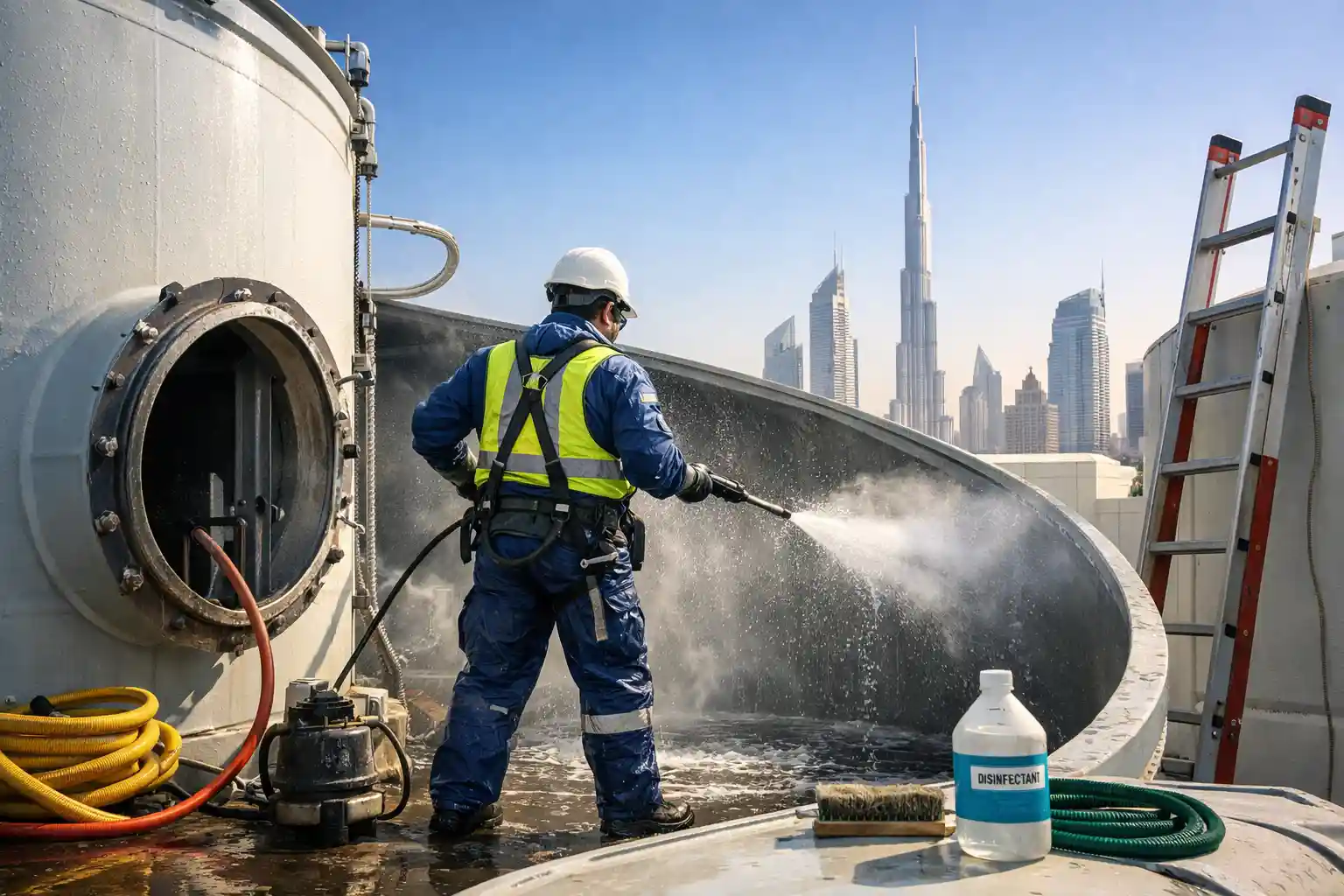
A reliable water tank cleaning process should follow a controlled sequence:
- Inspect the tank, cover, access area, vents, pipes, and surrounding hazards.
- Isolate the water supply and relevant electrical risks.
- Drain or remove the stored water responsibly.
- Extract sediment and loose contamination.
- Physically scrub accessible internal surfaces.
- Apply a suitable disinfectant at the correct concentration.
- Allow the required contact time.
- Rinse the tank properly.
- Inspect internal walls, coatings, fittings, and seals.
- Refill the tank and issue a service report.
Disinfection should not be used as a shortcut for physical cleaning. Sediment, slime, biofilm, and attached residue must first be removed so the disinfectant can reach the actual surface.
Property owners can review this detailed water tank cleaning checklist before the appointment to confirm that essential inspection and cleaning steps are included.
Records Property Owners Should Keep
Documentation provides evidence that cleaning and preventive maintenance have been completed responsibly. Dubai Municipality has stated that inspectors review water-tank cleaning, sterilisation, and preventive-maintenance reports in relevant regulated facilities.
A complete record should include:
- Property and tank identification
- Cleaning date
- Tank type and estimated capacity
- Contractor and technician details
- Condition before cleaning
- Cleaning and disinfection method
- Products used
- Defects discovered
- Repairs recommended or completed
- Before-and-after photographs
- Water-test results where applicable
- Recommended next inspection date
Keep digital copies of every report. An invoice alone may confirm payment but does not explain the tank’s condition, cleaning method, defects, or corrective action.
Ask for the completed report before the cleaning team leaves the property.
Underground and Overhead Tank Risks
Underground tanks can be affected by groundwater entry, damaged waterproofing, sediment, inaccessible corners, cracked surfaces, and contamination around the access cover. Their condition cannot be judged by looking at the water alone.
Understanding the benefits of underground water tank cleaning helps property owners identify structural and hygiene risks before they develop into water-quality complaints or expensive repairs.
Overhead tanks face different challenges, including direct heat, windblown dust, sunlight exposure, damaged lids, and poorly protected vents. Their supports, access routes, overflow pipes, and surrounding roof areas should be checked during maintenance.
The service report should distinguish between removable contamination and structural defects requiring repair.
What to Do If Tank Water Looks Dirty
Dirty water may originate from the tank, internal pipes, recent plumbing work, corrosion, stagnation, damaged fittings, or a temporary supply issue. Cleaning the tank without investigating the complete distribution path may leave the real cause unresolved.
Do not use visibly contaminated or unusually smelling water for drinking or food preparation until the source has been assessed. Arrange a professional inspection and consider laboratory testing when contamination is suspected or required by the facility’s risk procedures.
The safe water tank cleaning process explains how to recognise contamination and respond without using unsafe chemicals or incomplete DIY methods.
When water changes colour, smell, or taste, stop guessing and request an immediate professional assessment.
Common Compliance Mistakes
Waiting Until the Water Looks Dirty
Contamination or sediment may be present before visible changes occur. Scheduled preventive cleaning is more dependable than waiting for complaints.
Hiring an Unverified Contractor
A general cleaning licence does not automatically demonstrate approval to clean potable-water tanks. Verify the activity and documentation.
Keeping Only an Invoice
A proper compliance file should contain cleaning, disinfection, inspection, testing, and corrective-action details.
Ignoring the Plumbing Network
A cleaned tank cannot correct contamination inside corroded, stagnant, or poorly maintained pipes.
Using Disinfectant Without Cleaning
Chemicals cannot reliably remove attached sediment, biofilm, or physical debris from tank surfaces.
Missing the Six-Month Review
Dubai Municipality advises residents to have tanks and plumbing systems cleaned and disinfected at least every six months through approved companies.
Water Tank Compliance Checklist
Use this practical checklist:
- Confirm the most recent cleaning date.
- Inspect the cover, vents, pipes, and access area.
- Verify the contractor’s licence and approval.
- Request the cleaning method in writing.
- Confirm that physical cleaning precedes disinfection.
- Ask which products and concentrations will be used.
- Keep before-and-after photographs.
- Obtain the completed condition report.
- Record repairs and corrective actions.
- Arrange water testing where required.
- Schedule the next service before the due date.
Book the next cleaning when the current service is completed so compliance does not depend on memory.
Final Recommendation
Water tank compliance in Dubai requires more than occasionally draining the tank. Follow Dubai Municipality’s six-month domestic cleaning and disinfection guidance, use an approved provider, inspect the complete system, and retain detailed maintenance records.
The safest decision is to act before water quality changes. Review your latest cleaning certificate now, verify the condition of the tank and plumbing system, and schedule professional cleaning when the six-month service date is approaching or contamination is suspected.
Frequently Asked Questions
How often should residential water tanks be cleaned in Dubai?
Dubai Municipality advises residents to clean and disinfect domestic water tanks and plumbing systems at least once every six months using an approved company.
Must the water tank cleaning company be approved?
Yes. Property owners should use a properly licensed provider with approval for the relevant water-tank-cleaning activity. Dubai Municipality provides an approval process for companies performing this work.
What documents should I receive after cleaning?
Request a service report containing the date, tank condition, cleaning method, products used, defects found, photographs, corrective recommendations, and next inspection date.
Is water testing required after every tank cleaning?
Testing requirements can vary by facility type, risk level, complaint history, and authority instructions. Regulated properties should follow their applicable inspection and testing programme.
Can disinfectant clean a dirty tank without scrubbing?
Not effectively when sediment, slime, biofilm, or attached deposits are present. Physical cleaning should generally take place before disinfection.
What should I do when the water smells unusual?
Avoid using suspicious water for drinking or food preparation, arrange an inspection, and investigate both the tank and internal distribution system.